



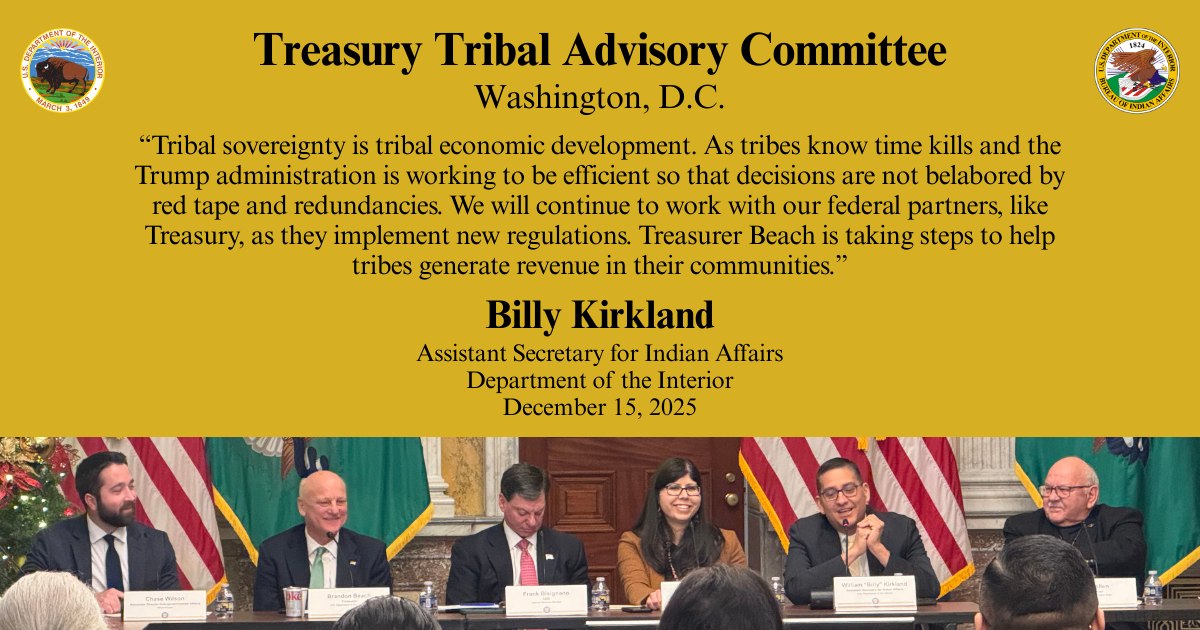
January 2026 marks a watershed moment in the history of American Indian Tribes. The finalization of Treasury Regulation Section 1.139E-1 represents the most significant federal recognition of Tribal sovereignty in tax policy in generations—a milestone achieved through unprecedented collaboration between US Treasury Secretary Scott Bessent, the Internal Revenue Service, and the Treasury Tribal Advisory Committee.
While we encourage you to read the entire scope of the 101-page ruling found on the official U.S. Department of the Treasury website, RWLGS’ analysis breaks down what Indian Tribes need to know now.
Why This Matters: A Historic Turning Point
For decades, Indian Tribes have operated their general welfare programs under a cloud of uncertainty. Would the IRS challenge Tribal housing assistance? Would educational benefits be taxed? Could cultural and ceremonial support be considered taxable income? These questions hung over Tribal programs, forcing conservative approaches that limited the very support Tribal governments sought to provide their people.
That uncertainty ends now.
The Section 139E final rule doesn’t just provide clarity—it fundamentally transforms the relationship between Tribal governments and the federal tax system by codifying Tribal sovereignty as the cornerstone principle. This regulation declares, in unambiguous terms, that Indian Tribes possess the inherent authority to determine what benefits promote the general welfare of their communities, free from IRS second-guessing or federal micromanagement.This is not merely a technical tax regulation. This is a recognition of sovereignty enshrined in the Internal Revenue Code.
A Collaborative Achievement
The finalization of the 139E regulation embodies the principle that Tribal governments—like state and local governments—should be empowered to serve their citizens without federal tax interference undermining their programs.
Tribes had sought guidance on general welfare for a decade and asked to confirm the tax status of Tribal businesses for 30 years. The first Trump Administration took action by standing up the TTAC, leading to substantial Tribal consultation. And the second Trump Administration has gotten this across the finish line, supporting our effort to grow our economies and strengthen our communities on our own terms, without federal paternalism.
-W. Ron Allen, TTAC Chair and CEO of the Jamestown S’Klallam Tribe
Treasury Secretary Scott Bessent has championed this regulation as part of a broader commitment to economic empowerment and recognition of sovereign authority. Under Secretary Bessent’s leadership, the Treasury Department has prioritized:
- Respect for sovereign decision-making
- Elimination of regulatory uncertainty that impedes Tribal programs
- Recognition that Tribes know best what their communities need
- Parity with other governments in tax treatment
Secretary Bessent understands that true economic development in Indian Country requires regulatory certainty and respect for Tribal governmental authority.
The Internal Revenue Service, working in coordination with the Treasury Department, has taken the unprecedented step of deferring to Tribal judgment in matters of general welfare. This represents a fundamental shift in approach—from skepticism and audit threats to partnership and respect.
The IRS has committed to:
- Presuming Tribal determinations are correct unless clearly erroneous
- Not second-guessing Tribal priorities regarding community welfare
- Providing safe harbor protections for properly structured programs
- Recognizing Tribal expertise in serving their own communities
The Treasury Tribal Advisory Committee (TTAC) played an indispensable role in shaping this regulation. Through extensive consultation, testimony, and advocacy, TTAC members ensured that:
- Tribal voices were heard and respected throughout the rulemaking process
- Practical realities of Indian Country informed regulatory language
- Sovereignty principles were non-negotiable in the final rule
- Cultural and traditional practices received explicit protection
This collaboration exemplifies the level of meaningful government-to-government consultations Indian Tribes have demanded for decades—federal officials genuinely listening to and incorporating Tribal expertise and concerns.
What Section 139E Actually Does: Revolutionary Scope
The Core Principle: Tribal Sovereignty
At the heart of Section 139E lies this revolutionary principle:
Indian Tribal governments have the sole authority to determine whether their programs promote general welfare.
The IRS cannot override this determination. Federal officials cannot substitute their judgment. State governments have no say. The Tribe decides.
This is sovereignty in action.
The Unprecedented Breadth: What’s Covered
The final rule explicitly recognizes that Tribal general welfare benefits can include virtually any program a Tribe determines promotes community welfare:
🏠 Housing & Infrastructure
- Down payments and mortgage assistance
- Rent payments
- Utility assistance
- Home repairs and rehabilitation
- New construction support
- Emergency housing
- Habitability improvements
Impact: Tribes can now aggressively address housing crises without recipients facing tax consequences that would undermine the assistance.
💼 Economic Development
- Business start-up grants
- Small business loans (below-market rate)
- Equipment purchases
- Business training and support
- Employment assistance
- Job placement programs
- Entrepreneurship education
Impact: Tribes can foster economic self-sufficiency without tax consequences discouraging participation.
I’m encouraged to see the Treasury Department take these steps to improve how tax policies affect our Tribes. Clarifying that Tribally chartered businesses are exempt from income taxes and fully implementing the Tribal General Welfare Exclusion Act will help Native communities and encourage economic development…
-Senator Catherine Cortez Masto (D-NV)
📚 Education at All Levels
- Preschool through graduate school tuition
- Books, supplies, and equipment
- Room and board
- Computers and technology
- Vocational training
- Adult education
- Cultural education programs
- Child care to enable education
Impact: Tribal scholarship and education programs—often the most robust in Indian Country—now have complete certainty and protection.
👴 Elder Care & Support
- In-home care services
- Meals programs
- Day care facilities
- Transportation services
- Home modifications (ramps, grab bars, etc.)
- Companion services
- Respite care for families
- End-of-life support
Impact: Tribes can honor elders through comprehensive support programs without tax burdens on vulnerable populations.
🚗 Transportation
- Vehicle purchase assistance
- Vehicle repairs
- Mileage reimbursement
- Gas cards
- Public transportation subsidies
- Ride-sharing support
- Transportation to medical appointments
- Transportation to cultural events
Impact: In rural Indian Country where transportation is often a critical barrier, Tribes can now provide comprehensive mobility support.
🪶 Cultural & Ceremonial Programs
- Powwow expenses
- Traditional ceremony costs
- Regalia and traditional items
- Language preservation programs
- Cultural education
- Funeral and burial assistance
- Naming ceremonies
- Coming-of-age ceremonies
- Items of cultural significance
Impact: This may be the most profound aspect—explicit federal recognition that cultural and ceremonial activities are legitimate governmental functions promoting general welfare. This validates what Tribes have always known: culture is not a luxury but essential to community health and identity.
🏥 Health & Wellness Programs
- Wellness programs (gym memberships, fitness classes)
- Nutritional programs
- Traditional healing and medicines
- Mental health support
- Substance abuse programs
- Prevention and health education
- Care provided by family members
- Non-prescription health items
Impact: Fills critical gaps left by Section 139D medical programs, allowing Tribes to address health holistically—including traditional healing practices and family-based care models that reflect Tribal values.
⚖️ Legal, Social & Emergency Services
- Legal assistance and representation
- Social services programs
- Emergency disaster relief
- Crisis intervention
- Temporary shelter
- Food assistance
- Clothing assistance
- Household goods
Impact: Comprehensive safety net programs can operate without fear of creating tax liabilities for those receiving emergency assistance.
The Sovereignty Revolution: What Makes This Different
1. Sole Tribal Authority
Previous IRS guidance and court cases often subjected Tribal programs to federal scrutiny using criteria developed for state and local governments. The 139E regulation breaks from this approach entirely.
The regulation states explicitly: The determination of whether a benefit promotes general welfare is made by the Indian Tribal government alone.
This means:
- ✅ The Tribe defines “general welfare” for its community
- ✅ The Tribe determines program eligibility
- ✅ The Tribe decides benefit levels
- ✅ The Tribe establishes distribution methods
- ❌ The IRS does not second-guess these determinations
- ❌ Federal officials do not apply their own welfare criteria
- ❌ Non-Tribal standards do not override Tribal judgment
2. Presumption of Validity
The regulation creates a presumption that benefits provided under written Tribal programs are for general welfare purposes.
This shifts the burden dramatically:
- Old approach: Tribe must prove to IRS that program qualifies
- New approach: IRS must overcome presumption that Tribal determination is correct
This is a sovereignty-based presumption—the federal government starts from a position of respect for Tribal governmental decisions.
3. Cultural Recognition
For the first time in IRS history, a regulation explicitly recognizes that cultural and ceremonial activities are legitimate governmental functions that promote general welfare.
The preamble to the final rule states:
“The Treasury Department and the IRS recognize that cultural and ceremonial programs are an important aspect of Indian Tribal Governments’ provision of benefits for the promotion of general welfare.”
This is revolutionary. The federal government is acknowledging that:
- Culture is not separate from welfare—it’s central to it
- Traditional practices are governmental functions
- Ceremonial support is as legitimate as housing or education
- Tribal values define what constitutes “welfare”
This validates Indigenous knowledge and governance in federal law.
4. No Individual Need Requirement
Traditional welfare programs often require demonstrating individual financial need. Section 139E rejects this approach for Tribal programs.
Tribes can provide benefits:
- Uniformly to all members
- On a pro-rata basis (per capita distributions with general welfare purposes)
- Based on Tribal-defined criteria
- Without means testing
Why? Because Tribes may determine that uniform distribution or cultural criteria (such as participation in ceremonies, age-based distribution, or family status) better serve their communities’ welfare than means-based approaches.
This respects diverse Tribal values and governance traditions.
5. Protection from IRS Challenge
The regulation establishes clear safe harbors and standards that protect Tribal programs from IRS challenge:
Written Program Safe Harbor: Programs with written documentation receive presumption of validity.
Established Categories: Benefits in the regulation’s examples are explicitly recognized.
Deference to Tribal Determinations: Even without written programs, Tribal determinations receive respect.Burden on IRS: To challenge a program, the IRS must show it’s “not for the promotion of general welfare”—a high bar when Tribes have made that determination.
Comparing 139E with 139D: Understanding Both Tools
Many Tribes are familiar with Section 139D, which excludes qualified Indian health care benefits from taxation. It’s important to understand that 139E and 139D work together, not in competition.
Section 139D: Indian Health Care Benefits
- Scope: Medical services and health coverage
- Source: IHS, Tribal 638 programs, IHS-funded services
- Standard: Must be “medical care” (generally Section 213(d) definition)
- Authority: Defined by federal programs and medical necessity
- Examples: Doctor visits, hospital care, prescriptions, medical equipment
Section 139E: Tribal General Welfare Benefits
- Scope: ANY benefit Tribe determines promotes general welfare
- Source: Tribal government programs
- Standard: Tribal determination of general welfare
- Authority: Tribal sovereignty
- Examples: Everything listed above, including health/wellness benefits not covered by 139D
The Overlap: Health and Wellness
This is where 139E becomes especially powerful:
Example 1: Traditional Healing Ceremony
- May or may not qualify under 139D (depends on medical necessity and program structure)
- Definitely can qualify under 139E as cultural/ceremonial or health program if Tribe so determines
Example 2: Gym Membership for Wellness
- Generally does NOT qualify under 139D (not “medical care”)
- CAN qualify under 139E if Tribe determines wellness programs promote general welfare
Example 3: Family Member Providing Elder Care
- Generally does NOT qualify under 139D (unlicensed care)
- CAN qualify under 139E as elder care or cultural obligation
Example 4: Traditional Foods/Medicines
- May NOT qualify under 139D unless prescribed
- CAN qualify under 139E as cultural, nutritional, or wellness program
The Power: Section 139E allows Tribes to provide holistic, culturally-appropriate health and wellness programs that 139D’s medical model doesn’t cover.
Real-world Impact: Transforming Tribal Programs
Scenario 1: Comprehensive Elder Support
Before 139E Finalization:
A Tribe wanted to support elders through monthly stipends for cultural participation, payments to family members providing care, and assistance with ceremonial expenses. Concern about tax implications led to a scaled-back program focused only on direct medical needs.
After 139E Finalization:
The Tribe implements a comprehensive elder program including:
- Monthly cultural participation stipends (encouraging ceremony attendance)
- Payments to family caregivers (honoring traditional care models)
- Traditional healing services
- Home modifications for safety
- Funeral and burial assistance
- Transportation to cultural events
- Meals programs incorporating traditional foods
Impact: Elders receive holistic support reflecting Tribal values. Family members can afford to provide care. Cultural participation increases. No tax consequences for recipients.
Scenario 2: Educational Sovereignty
Before 139E Finalization:
A Tribe’s scholarship program covered tuition but was uncertain about providing stipends for cultural education, language immersion programs, or support for students pursuing traditional knowledge alongside formal degrees.
After 139E Finalization:
The Tribe expands its program to include:
- Full tuition, books, supplies, and room/board for all education levels
- Stipends for cultural education and language immersion
- Support for traditional knowledge apprenticeships
- Computers and technology for students
- Child care assistance so parents can pursue education
- Support for graduate students studying Indigenous issues
Impact: Education becomes truly holistic, incorporating both Western and traditional knowledge. Student burden eliminated—scholarships are pure support, not taxable income.
Scenario 3: Housing Crisis Response
Before 139E Finalization:
Facing severe housing shortages, a Tribe wanted to provide down payment assistance, monthly rent support, and emergency repair funds but worried about creating tax burdens for recipients already struggling financially.
After 139E Finalization:
The Tribe launches a comprehensive housing initiative:
- Down payment assistance for first-time homebuyers
- Monthly rent subsidies for low-income families
- Utility assistance during winter months
- Emergency repair funds for critical home safety
- New construction support for multi-generational homes
- Renovation assistance to accommodate elders
Impact: Housing support reaches those who need it most without tax consequences that would undermine the assistance. Families can accept help without fear.
Scenario 4: Cultural Revitalization
Before 139E Finalization:
A Tribe wanted to support cultural programs but hesitated to provide financial assistance for regalia, ceremony participation, or traditional items, uncertain whether such benefits would be considered taxable gifts.
After 139E Finalization:
The Tribe implements a cultural support program:
- Regalia assistance for dancers and ceremony participants
- Support for traditional item creation (drums, pipes, etc.)
- Funding for language learning programs
- Support for naming ceremonies and coming-of-age rites
- Assistance with travel to cultural gatherings
- Payments to culture bearers and traditional knowledge keepers
Impact: Cultural revitalization accelerates. Youth participation in traditional practices increases. Elders’ knowledge is honored and compensated. Culture thrives without tax barriers.
Scenario 5: Economic Development Without Barriers
Before 139E Finalization:
A Tribe wanted to foster entrepreneurship through start-up grants and below-market loans but worried recipients would face immediate tax liabilities before businesses generated revenue.
After 139E Finalization:
The Tribe creates a comprehensive economic development program:
- Business start-up grants (non-taxable)
- Below-market rate loans
- Equipment purchase assistance
- Business training and mentorship
- First-year operational support
- Marketing and development assistance
Impact: Tribal members can launch businesses without immediate tax burdens. Economic self-sufficiency becomes achievable
Implementing Section 139E: Next Steps for Indian Tribes
Step 1: Understand Your Authority
Key Recognition: Your Tribe has inherent sovereignty to determine what promotes general welfare in your community. This regulation codifies that authority.
You don’t need permission. You don’t need to copy another Tribe’s approach. You define welfare based on your community’s values, needs, and traditions.
Step 2: Review Existing Programs
Examine current programs that may already qualify under 139E:
- Scholarship and education programs
- Housing assistance
- Elder support
- Cultural programs
- Per capita distributions with general welfare purposes
- Health and wellness programs
- Emergency assistance
- Economic development initiatives
Good news: Many existing programs likely already qualify—139E provides certainty and protection.
Step 3: Document Tribal Determinations
While not legally required, written program documentation creates a presumption that benefits are for general welfare.
Consider documenting:
- Program purpose: How does this promote general welfare?
- Eligibility criteria: Who receives benefits and why?
- Benefit levels: What is provided?
- Tribal authority: Resolution or ordinance establishing program
- Cultural context: How does this reflect Tribal values?
Note: Documentation doesn’t mean federal-style bureaucracy. Simple, clear program descriptions are sufficient.
Step 4: Think Holistically
Section 139E invites Tribes to think beyond traditional welfare categories. Consider:
Cultural Integration: How can programs honor traditional practices?
- Support for ceremony participants
- Traditional healing alongside Western medicine
- Language and cultural education
- Support for culture bearers
Family-Centered Approaches: How can programs strengthen families?
- Multi-generational housing support
- Payments to family caregivers
- Child care to enable parent education/employment
- Family participation in cultural events
Prevention and Wellness: How can programs address root causes?
- Wellness programs preventing future health costs
- Traditional foods addressing diet-related illness
- Cultural connection reducing substance abuse
- Education breaking cycles of poverty
Sovereignty Expression: How do programs reflect self-determination?
- Criteria based on Tribal values, not federal standards
- Distribution methods honoring Tribal traditions
- Programs addressing Tribally-identified priorities
Step 5: Expand Confidently
With 139E certainty, Tribes can now expand programs that previously seemed too risky:
Bold Housing Initiatives: Comprehensive support beyond basic shelter—down payments, utilities, repairs, modifications for elders and disabilities.
Cradle-to-Career Education: Full support from early childhood through graduate school, including cultural education.
Comprehensive Elder Care: Honoring elders through robust support including family caregiver payments, cultural participation, and traditional care.
Cultural Revitalization: Direct financial support for ceremony participation, traditional item creation, and cultural education.
Economic Empowerment: Aggressive business development support without tax barriers limiting effectiveness.
Step 6: Educate Tribal Members
Many Tribal members may not understand that benefits are tax-free. Providing clear information:
- Reduces anxiety about accepting assistance
- Increases program participation
- Builds trust in Tribal government
- Demonstrates Tribal sovereignty in action
Consider:
- Simple fact sheets on tax-free status
- Inclusion in benefit award letters
- Community presentations on 139E
- Success stories showing positive impacts
Step 7: Coordinate with Tax Professionals
Ensure Tribal tax staff, accountants, and benefits administrators understand 139E:
- Benefits don’t require 1099 reporting to recipients
- No tax withholding on general welfare benefits
- Documentation supports programs but isn’t burdensome
- Tribal determination is paramount
Step 8: Consider Revenue Implications
For Tribes with per capita distributions from gaming or other revenue:
Question to Analyze: Are distributions for general welfare purposes?
If a Tribe determines that revenue distributions serve general welfare (supporting member well-being, reducing poverty, enabling economic participation), those distributions may qualify under 139E.This is a Tribal determination based on program purpose and community welfare—not a federal standard.
The Sovereignty Milestone: Why This Is Historic
Recognition of Governmental Authority
For generations, Tribal governments have fought for recognition as true governments with full sovereign authority. Yet federal agencies often treated Tribal programs with skepticism, applying different standards than those used for state and local governments.
Section 139E ends this disparate treatment in tax policy. The regulation explicitly recognizes that:
- Tribal governments are governments—not charitable organizations or social service providers
- Tribal welfare determinations are governmental decisions—entitled to deference and respect
- Tribal programs reflect sovereign choices—not subject to federal second-guessing
- Tribal values define welfare—not one-size-fits-all federal standards
This is parity in action—Tribes receiving the same respect afforded to state and local governments.
Validation of Cultural Governance
Perhaps most profoundly, Section 139E validates that Indigenous governance models are legitimate.
Traditional Indigenous governance has always been holistic—not separating economic support from cultural participation, or individual welfare from community health. Western governance models compartmentalize: this agency handles housing, that agency handles culture, another handles health.
Section 139E allows Tribes to govern according to their own traditions:
- Culture and ceremony as central to welfare
- Family and community relationships as governance structures
- Holistic approaches integrating multiple domains
- Traditional knowledge equal to Western expertise
The federal government is finally catching up to what Tribes have always known: effective governance requires cultural grounding and community-specific approaches.
Self-Determination in Practice
The Indian Self-Determination and Education Assistance Act (ISDEAA) established the principle that Tribes should control programs serving their communities. Yet implementation often involved federal oversight, reporting requirements, and standards that limited true self-determination.
Section 139E represents self-determination in its purest form:
- Tribes decide what programs to operate
- Tribes determine what promotes welfare
- Tribes establish eligibility and benefits
- Federal role: Respect those decisions
No federal approval needed. No federal standards imposed. No federal micromanagement.
This is what self-determination looks like.
Economic Development Catalyst
Uncertainty about tax treatment has long hindered Tribal economic development and social programs. Questions about whether benefits would be taxed created:
- Conservative program design: Tribes offered less than optimal support
- Limited participation: Members feared tax consequences
- Reduced effectiveness: Tax burdens undermined assistance
- Administrative burden: Extensive documentation to defend programs
- Legal costs: Defending programs against IRS challenges
Section 139E removes these barriers:
- ✅ Tribes can be bold: Comprehensive programs without fear
- ✅ Members can accept help: No tax anxiety
- ✅ Programs work better: Full value reaches recipients
- ✅ Administration simplified: Presumption of validity reduces documentation burden
- ✅ Legal certainty: Clear standards prevent challenges
Economic development and social support can reach full potential.
Inter-Governmental Respect
Section 139E embodies the government-to-government relationship at its best. The collaborative process that produced this regulation demonstrates how federal-Tribal relations should work:
Federal officials listened to Tribal representatives and incorporated their expertise.
Tribal voices shaped policy through TTAC and consultation.
Sovereignty was non-negotiable as the foundation principle.
Cultural competence informed regulatory language and examples.
Partnership replaced paternalism in the final product.
This sets a standard for future federal-Tribal collaboration.
The Path Forward: Maximizing This Opportunity
For Tribal Leaders
This regulation is a tool—but only if Tribes use it. Tribal leaders should:
- Educate Tribal Councils: Ensure leadership understands the scope and sovereignty implications of 139E.
- Review and Expand Programs: Examine existing programs and identify expansion opportunities now possible with regulatory certainty.
- Think Creatively: Don’t limit thinking to traditional welfare categories. Consider how your Tribal values define welfare and design programs accordingly.
- Document Thoughtfully: Create program documentation that reflects Tribal sovereignty while providing clarity.
- Communicate Benefits: Ensure Tribal members understand that these programs are tax-free, encouraging participation.
- Share Success Stories: As programs expand and succeed, share outcomes with other Tribes and federal partners.
- Assert Sovereignty: Use 139E as a model for demanding respect in other federal policy areas.
For Tribal Program Administrators
You are implementing sovereignty. Your work operating these programs puts self-determination into practice daily.
- Understand 139E Fully: Become expert in the regulation’s scope and requirements.
- Simplify Administration: Don’t over-complicate documentation—the regulation protects Tribal determinations.
- Support Cultural Programs: Recognize that cultural and ceremonial support is as legitimate as housing or education.
- Educate Recipients: Help Tribal members understand tax-free status.
- Track Outcomes: Document positive impacts to demonstrate program effectiveness.
- Coordinate Across Programs: Consider how 139E programs can work with 139D health programs and other initiatives.
For Tribal Members
These benefits are yours by right, not charity. Your Tribal government is exercising sovereignty to serve the community.
- Understand Your Rights: Benefits under 139E are tax-free—you don’t owe federal income tax on them.
- Participate Fully: Don’t avoid programs due to tax fears. If your Tribe offers assistance, accepting it won’t create tax liability.
- Maintain Records: Keep documentation of benefits received for your own records (though extensive recordkeeping isn’t required).
- Support Tribal Programs: Participation strengthens programs and demonstrates their importance.
- Provide Feedback: Share with Tribal program staff what’s working and what could improve.
For Tribal Tax Professionals and Attorneys
You play a crucial advisory role in implementing 139E effectively.
- Master the Regulation: Understand both the text and preamble thoroughly.
- Advise Confidently: The regulation provides strong protection—advise Tribes to use it.
- Draft Thoughtfully: Program documentation should reflect Tribal sovereignty while providing clarity.
- Educate Widely: Help Tribal leaders, staff, and members understand 139E.
- Stay Current: Monitor any guidance or developments from Treasury / IRS.
- Share Knowledge: Contribute to Tribal professional networks and resources.
Assert Sovereignty: If IRS questions arise, start from the position that Tribal determinations receive deference.
For Additional Next-Steps Guidance
This final ruling provides the necessary framework to level the playing field for true economic sovereignty for Indian Tribes, offering countless avenues for supercharging investment in Indian Country: enterprises, housing, infrastructure, community wellness, and more. RWLGS provides consultation services and lived-experience guidance from Indians for Indians across a diverse scope of specialties and industries:
- Affordable Housing: Design-Build — Built-in “Smart Tribe” (Smart City)-technology, Solar, Sustainable and Eco-Friendly, Unmatched durability that meets and exceeds ICC Codes and Standards, Rapid Construction
- Film Studios and Media Campus Development / Consultation— Design-Build Consultation, Site Selection, Operations and Facility Management, Sales / Business Development, Specialty Tax Incentives, and more
- Tourism / Hospitality Consultation: Branded Environments, Casino / Resort, Co-Branded Entertainment Partnerships, Franchise Consultation, and more
- Management Consultation for Tribal Enterprises: Operations Improvement, Annual Reports, Workforce Development, New Business, Executive Coaching, and more
- Tribal and Private Partnerships: Diligence, New Business Development, Major Brands
- Brand Development
- Public Relations and Media Training for Tribal Leaders and Council Members, Executives, Public Information Officers, and Department Leads
- “Success Secrets for Sovereignty” Leadership Training for new leaders and key personnel